
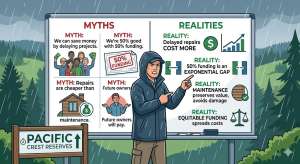
At Pacific Crest Reserves, we help condominium and homeowner associations throughout the Pacific Northwest navigate the long-term financial and physical needs of their communities. Reserve studies are a critical planning tool—yet we regularly see well-intentioned boards make decisions based on common misconceptions that create major financial and maintenance hurdles down the road.
Here are the five most common reserve study misunderstandings we encounter among associations in Washington and the broader Pacific Northwest:
1. “If we contribute half of the recommended funding, we’ll still be mostly okay.”
This is one of the most expensive misunderstandings in reserve planning. Reducing recommended reserve contributions by 50% does not mean you are “halfway prepared.” In reality, it triggers an exponential, long-term funding gap.
For many associations, a modest monthly dues increase secures financial stability. Conversely, consistently starving reserves typically results in a cascade of negative consequences:
- Compounded deferred maintenance and costly emergency repairs
- Sudden, stressful special assessments
- Reduced property values and difficulty obtaining buyer financing
PNW Reality Check: In our damp climate, where moisture intrusion and building envelope deterioration are constant threats, inadequate reserves become punishingly expensive very quickly.
2. “Delaying projects will save us money right now.”
In our experience, delayed maintenance almost never saves money—it multiplies costs. A properly timed repair project can be completed in a controlled, cost-effective manner. But when projects are kicked down the road, secondary damage develops. What started as a simple exterior maintenance task quickly evolves into structural dry rot remediation or full component replacement.
We regularly witness preventable escalations, such as deck coating touch-ups turning into structural framing rebuilds, or sealant failures leading to hidden framing deterioration.
3. “Future owners can deal with it.”
Reserve deterioration begins the very day a component is installed. Roofs, siding membranes, asphalt, and elevators depreciate every single year. Reserve contributions are designed to offset the ongoing wear and tear that occurs during each owner’s period of residency.
When associations avoid funding reserves appropriately, current owners enjoy the amenities while shifting the true cost of ownership onto future buyers. This creates severe inequity within the community and ultimately results in massive special assessments that tank property marketability.
4. “We don’t really need to update our reserve study frequently.”
Accurate decisions require current data. Construction costs, inflation, material pricing, and labor availability change constantly. In recent years, Pacific Northwest associations have experienced dramatic price spikes in roofing materials, insurance premiums, skilled labor, and waterproofing specialties.
An outdated reserve study creates a false sense of security and leads boards to severely underestimate future funding needs. Because reserve contributions are typically one of the largest line items in an association’s budget, regular updates are a board’s single most valuable financial planning tool.
5. “Our association simply can’t afford proper reserve funding.”
In reality, most associations cannot afford not to fund their reserves. Underfunding doesn’t make physical costs disappear; it just postpones them into a much more aggressive, expensive form.
For most condominium associations, achieving a fully funded status amounts to a relatively modest monthly adjustment when spread evenly across all owners. The alternative is a stressful, expensive cycle of surprise special assessments, high-interest emergency bank loans, and declining building conditions that hurt pride of ownership.
Planning Over Prediction
No reserve study can perfectly predict the future. However, a well-prepared and regularly updated study from Pacific Crest Reserves gives your board the clarity needed to make informed, responsible decisions.
Strong associations aren’t the ones that try to avoid maintenance costs—they are the ones that plan for them early, communicate openly with their homeowners, and practice disciplined, long-term financial stewardship to protect community equity.
