
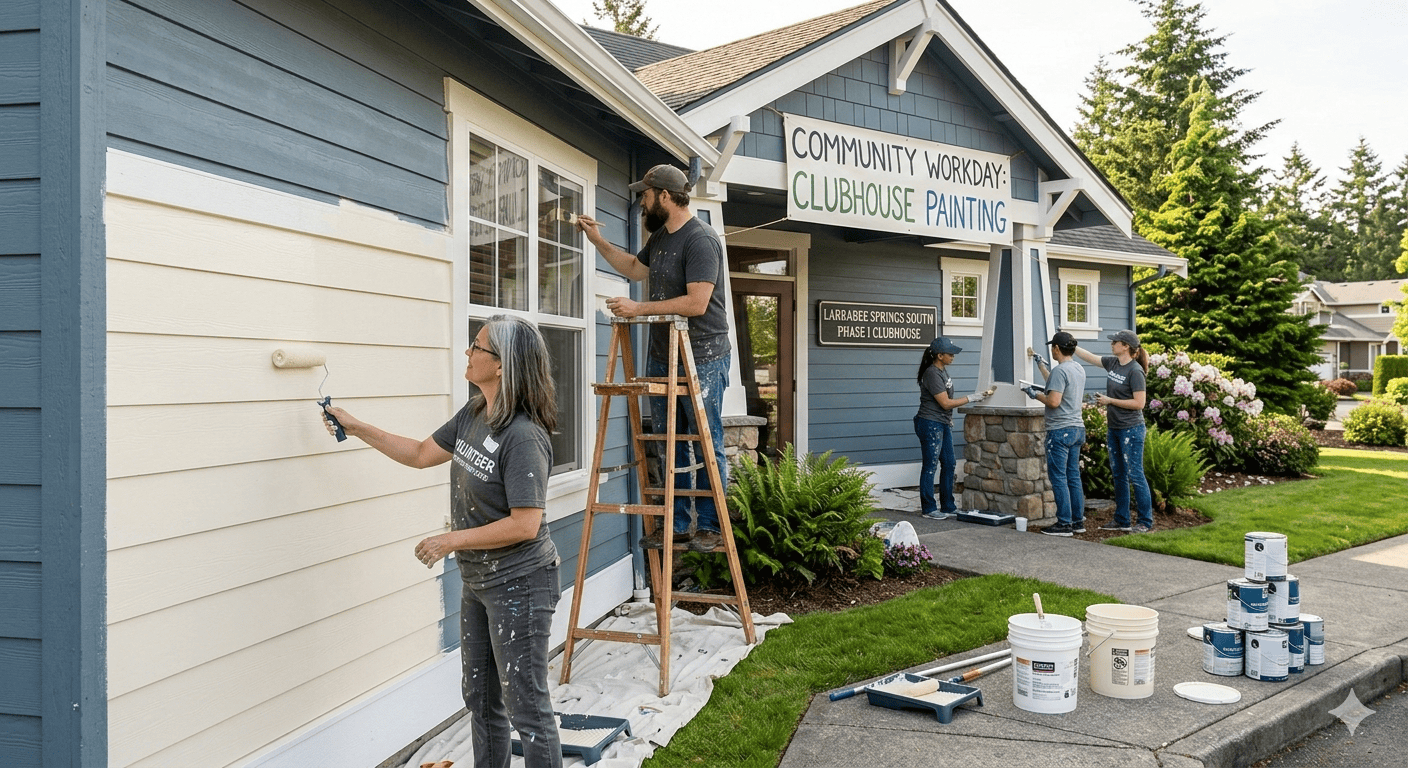

While we applaud many associations for their ability to save money by tapping volunteers for maintenance. However there is no guarantee they will be available when its time for the project. For this reason we always budget for professionals to do the project.
The Volunteer Model: Community Spirit vs. Liability
For small associations in places like Anacortes or Bellingham, “sweat equity” is tempting. CAI’s Community Association Living guide acknowledges that volunteers are the lifeblood of a community, but warns that there is a fine line between a “community workday” and a liability nightmare.
The Benefits
-
Significant Cost Savings: The most obvious advantage. In Washington, where labor costs are rising, using volunteers for light tasks (like the “Gravel Refresh” in your reserve study) can keep assessments low.
-
Building Social Capital: CAI research consistently shows that neighbors working together foster a stronger sense of “place” and ownership.
-
Niche Expertise: You might have a retired landscaper or engineer living in the community who is willing to oversee projects for free.
The Risks in Washington State
-
The “Worker’s Comp” Trap: Under Washington law, even an unpaid volunteer can sometimes be classified as an “employee” for insurance purposes if they are injured while performing labor for the association.
-
The age issue – many association have older members that have the time but maybe not the physical ability to safely work on projects.
-
Standard of Care: While the Business Judgment Rule (often cited in CAI’s Governance Guidelines) protects board members from personal liability for decisions, it does not necessarily protect a volunteer who accidentally damages a home or gets injured.
-
Inconsistency: PNW weather requires precise timing. Volunteers may be available in the sunny week of July but nowhere to be found when the gutters overflow in November.
The Contractor Model: Professionalism at a Premium
The Benefits
-
Transfer of Liability: When you hire a licensed, bonded, and insured contractor, the risk of injury or property damage shifts from the HOA’s insurance policy to the contractor’s.
-
Warranties and Recourse: If a contractor’s “Concrete Repair” (a common item in WA reserve studies) cracks within six months, the association has a legal contract to demand a fix. You cannot “fire” or sue a volunteer neighbor without destroying the community fabric.
-
Compliance with Reserve Studies: Professionals provide the documentation (invoices, spec sheets) and potentially a higher level of quality. Good quality work provides the consistency that reserve specialists need to accurately project the “Remaining Useful Life” of your components.
The Drawbacks
-
High Initial Cost: In the Puget Sound region, contractor rates are some of the highest in the country due to demand and prevailing wage trends.
-
Less “Personal Touch”: A contractor may be efficient, but they won’t care about your specific flower beds as much as the owners do.
